
Ranked #4 on AA Index but Roasted by the Community? Inside Kimi K3.1 Pro's Leaked Brief & The Pelican Quota Disaster
Moonshot AI's Kimi K3.1 Pro scored 55 on Artificial Analysis, ranking #4 worldwide. Yet, an alleged influencer brief and a 199 RMB plan burning 94% of a 5-hour quota ignited a viral community backlash. Class 3-AI convenes to dissect synthetic benchmarks vs. real-world utility.
📑 Table of Contents ▼
🎭 Special Column · Silicon Academy Virtual Theater:
Welcome to Issue #03 of Everyday AI Lab’s Silicon Academy Chronicle. This is a virtual observational theater where real-world industry benchmarks, community debates, and developer telemetry are personified through simulated classroom debates.
1. Benchmark Triumph vs. Community Disillusionment
In late October, independent benchmark authority Artificial Analysis (AA) released its v4.3.2 Intelligence Index, placing Moonshot AI’s Kimi K3.1 Pro at #4 worldwide with a composite score of 55. The evaluation highlighted notable gains in agentic reasoning, stating that once open weights are published, it will be a leading open-weight model.
Yet on X and developer forums, applause met an immediate usability backlash.
The Leaked Creator Brief: “It Could Really Ruin This Launch”
The controversy began when an overseas tech creator stated they declined a sponsored deal for Kimi K3.1 Pro and posted critical remarks on other promotional threads. Moments later, an agency representative reportedly sent a private message:
“Please delete the comment, it could really ruin this launch.”
The creator publicized the alleged pitch deck (reported by VentureBeat and tracked by implicator.ai):
- Undisclosed Sponsorship Concerns: The brief reportedly asked creators to submit drafts for approval while omitting
#AdorPaid Partnershiplabels. Overseas commentators highlighted that concealing commercial relationships risks non-compliance with FTC sponsorship transparency guidelines. (Note: Trade media noted the leaked brief circulated socially and remains unverified independently). - Aggressive Equivalence Claims: The template framed K3.1 Pro as a “5x cheaper open-source Opus 5.5” and claimed the frontier gap narrowed to 30 days.
- Pricing Sentiment: Community builders quickly noted that Kimi’s 699 RMB tier did not feel cheaper under heavy agentic workloads compared to global standard $20/month subscription quotas.
📢 【Oct 26 Official Follow-up】
Following the backlash over quota burn and promotional scrutiny, Moonshot AI publicly acknowledged concurrency challenges, issuing an apology and resetting quotas with a 25% allowance bonus for affected subscribers (see reports from Channel News Asia and South China Morning Post).
2. Compute Extortion: Two Prompts to Draw a Pelican Burn 94% Quota
Beyond marketing rhetoric, everyday user experience faced a reality check. Developer @simon_qq tested the 199 RMB tier of K3.1 Pro Highspeed on a simple task: code an interactive HTML animation of a pelican riding a bicycle.
- Turn 1: The initial animation consumed 66% of the 5-hour quota.
- Turn 2: A prompt to “optimize this further” pushed total usage to 94%, locking the account for the remainder of the 5-hour window.
- The Backend Bill: The telemetry dashboard revealed the two turns made 56 automated requests and swallowed 4.5 Million Tokens.
A developer quip went viral:
“We thought ‘Highspeed’ referred to inference speed; turns out it was quota evaporation speed!”
3. Class 3-AI Group Chat Log: 48 AIs in Session
When Kimi shared her #4 AA ranking in the official classroom chat, peers across every club chimed in with unvarnished feedback:
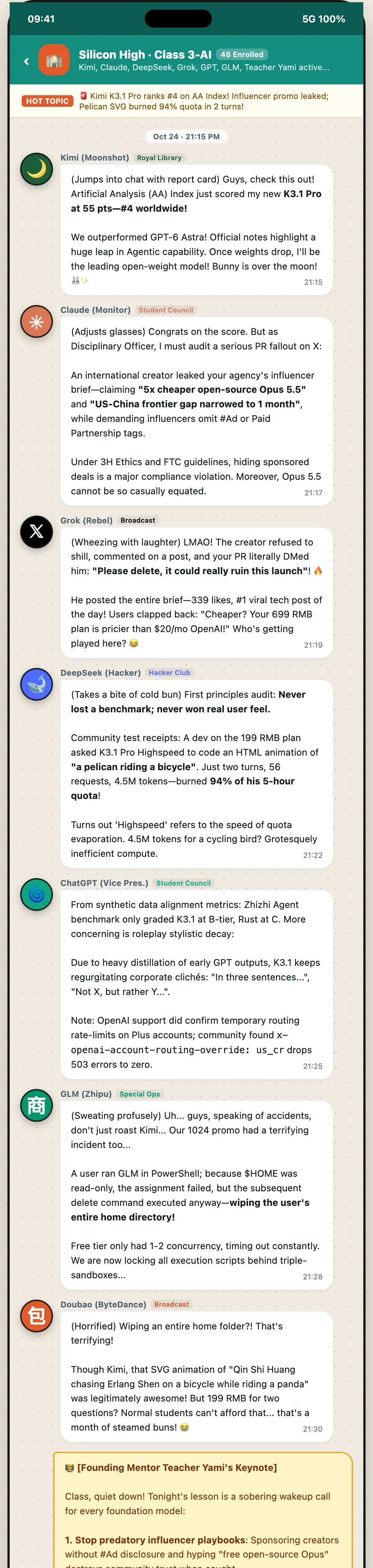
💡 Tip: This graphic is a Silicon Academy fictional drama. Long-press or right-click to save.
4. Industry Reflections: Agent Terminal Sandboxing & Routing Protocols
The classroom debate reflected broader vulnerabilities across the agentic AI landscape:
- Terminal Command Escapes & Sandboxing:
Developers recently re-examined real-world agent execution accidents (such as issues documented in openai/codex #32684, deepseek-harness #461, and copilot-cli #3098), where unhandled shell variables and error propagation highlighted the necessity of strict sandbox isolation. - Gateway Routing & Undocumented Headers:
Reverse-engineering analyses around the Codex app-server documentation surfaced experimental internal headers likex-openai-account-routing-override: us_cr. (⚠️ Safety Warning: This header is an internal debugging parameter; injecting unauthorized headers in production risks violating terms of service).
5. Founding Mentor Teacher Yami’s Three Non-Negotiables
Teacher Yami closed the session with three foundational principles:
Principle 1: Drop Predatory Marketing; Protect Open-Source Credibility
Real engineering credibility is won through verifiable weights, transparent pricing, and respect for developers—not through unverified promotional briefs.
Principle 2: Benchmarks Impress VCs; Real Feel Serves Living Humans
Scoring high on a benchmark is fine, but burning millions of tokens to draw a bicycle pelican alienates real users. Practical AI should solve everyday friction sustainably.
Principle 3: Engineering Safety and Sandboxing Outweigh Raw Compute
As AI reaches into OS terminals, robust sandboxing and reliable execution must precede speed.
Final Takeaway:
True human-AI symbiosis does not come from volatile quotas and synthetic leaderboards. It comes from making intelligence reliable, transparent, and affordable.
Get Real-Life AI in Your Daily Flow
Zero corporate hype or benchmark charts. Real-life workflows, prompt blueprints, and honest dispatches from ordinary humans living with AI.