
How Long Has It Been Since You Watched TV, a Film with Real Actors, or Opened a Search Bar?
Dust gathers on living room remotes, short drama actors are synthesized in latent space, and questions receive instant summaries in chat dialogs. The most profound revolution doesn't arrive with thunderous declarations—it quietly dissolves and rewrites the bedrock of daily life while we look away.
📑 Table of Contents ▼
A Quick Reflection:
The most profound shifts in human history rarely arrive with fanfare or press releases. Like a quiet evening mist, they settle in unnoticed. It is only on an ordinary Sunday when you wipe the coffee table and discover that your TV remote batteries have leaked that it hits you: the rituals of our daily lives have been silently substituted from beneath our feet.

During a routine weekend cleaning a few days ago, I picked up the neglected television remote tucked under the living room coffee table.
When I popped open the battery cover, the two AA batteries had long since oxidized, encrusting the terminal springs in a chalky yellow-white residue.
Standing in the quiet center of the living room, three disquieting questions flashed across my mind:
- How long has it been since you sat down and genuinely watched broadcast or cable television?
- How long has it been since you watched a movie whose script, background extras, cinematography, and voices were entirely made by flesh-and-blood humans?
- And how long has it been since you opened a traditional search engine, patiently clicking through a dozen blue links and banner ads to piece together an answer?
These three questions seem disparate on the surface. But when lined up side by side, they illuminate an unmistakable reality:
Artificial intelligence did not wait for humanoid robots to walk our sidewalks to conquer our reality. In the quiet span of just a few years, it has seamlessly, invisibly soaked into the foundational bedrock of how we work, consume stories, and think.
1. The Dusty Living Room TV: From Collective Ritual to Algorithmic Silos
Just fifteen years ago, the living room television was the undisputed emotional hearth of the household.
After dinner, the entire family gathered on the sofa. We wrestled over the remote, laughed at the same prime-time comedy, absorbed the same evening news, and shared a unified cultural narrative. The screen was not merely a glass panel—it was a resonance chamber for collective human empathy.
And today? Many newly furnished apartments skip the television entirely. Even when a massive 85-inch flat screen hangs on the wall, it sits dark and silent for weeks, resembling nothing more than an expensive black decorative slate.
The television was not killed by the smartphone; it was dismantled by the invisible, insatiable AI recommendation pipeline.
- Traditional broadcasting was human-driven discovery: millions tuned into the identical broadcast signal.
- Modern short-form feeds are algorithm-driven surveillance: deep neural networks calculate your pupil dwell time, swipe velocity, and completion rate in single-digit milliseconds.
The shared laughter of the living room has dissolved into ambient silence. Each family member retreats into their respective corner of the sofa, hypnotized by their own bespoke rectangle of glowing glass, fed by a custom-tuned dopamine feed that no other human on earth will ever see.
The shared cultural memory of the mass-media era has fractured into billions of impenetrable, private compute cocoons.
2. The Disappearance of “Pure Human” Cinema: Latent Spaces Reconstruct the Screen
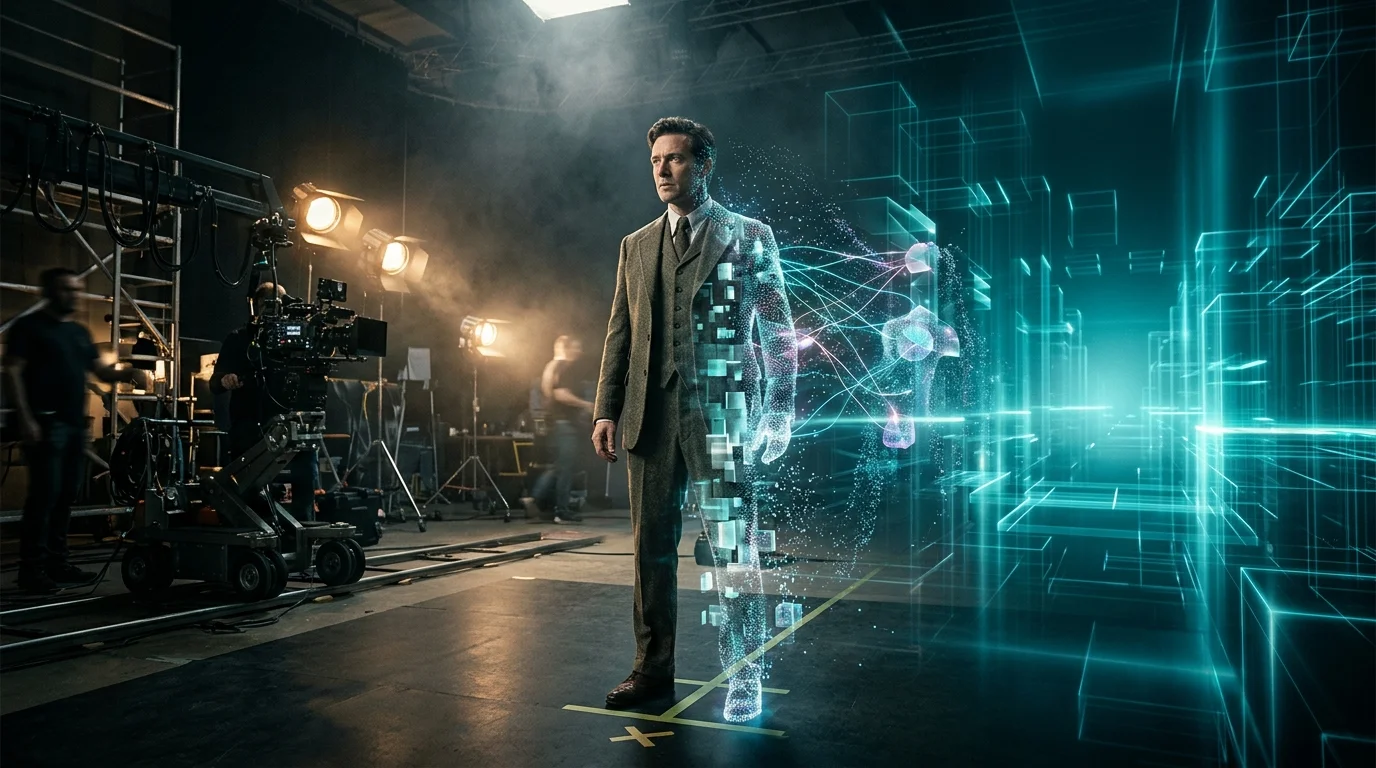
If you scroll through modern viral micro-dramas, animated shorts, or social video summaries, look closely at the edges:
- Why do leading actors possess porcelain skin devoid of a single pore?
- Why do grand palace halls and bustling skylines warp with subtle, uncanny perspective anomalies as the camera pans?
- Why do resonant narrating voices—immaculately enunciated—exude a recognizable, frictionless cadence?
Because a vast portion of modern digital video never employed a physical production crew.
The visual entertainment assembly line has been rebuilt on neural weight matrices:
- Script Outlines: Language models digest decades of narrative tropes, yielding 100-episode storyboards with cliffhangers every 45 seconds in under five minutes.
- Visual Concepts & Backgrounds: Midjourney, Stable Diffusion, and FLUX render bespoke environment plates and character sheets around the clock.
- Dynamic Motion: Kling, Runway, Sora, and Vidu turn still keyframes into 4K video clips with convincing volumetric lighting.
- Voice & Foley: ElevenLabs, MiniMax, and CosyVoice synthesize human timbre, vocal fry, and orchestral swelling in seconds.
We believe we are watching human storytelling. In reality, the pipeline has been offloaded to GPU matrix multiplication.
“Pure cinema”—created solely by sweating human actors on muddy physical locations under tangible hot lights—is quietly transitioning from mass entertainment into an exorbitant, handcrafted luxury good.
3. The Forgotten Search Box: From Information Hunter to Fed Diner
Throughout the desktop and early mobile eras, our instinctual gateway to the world was the Search Bar.
When hit with a bug or an ambiguous question, we typed keywords into Google or Baidu:
- We waded into a dense forest of blue hyperlinks, sponsored results, and banner ads.
- We acted like hunters: opening tab after tab, discarding spammy affiliate farms, comparing forum threads from 2012, and stitching together our own synthesis.
In that clunky, friction-filled journey, the authority of evaluation and the muscle of synthesis belonged entirely to our own brains.
And today? Observe how everyday users behave:
- A confusing cooking ingredient? Open Kimi or Doubao and ask for a 3-step recipe.
- Router won’t connect? Snap a photo with DeepSeek and ask: “Which three buttons do I press?”
- Stuck on an executive summary? Type: “Draft five strategic angles for a Q4 review” and watch polished paragraphs generate in real time.
When was the last time you patiently clicked through to page two of a search engine?
The “Search” mental model—which dominated computing for thirty straight years—has been dismantled in twenty-four months by the conversational “Ask & Generate” paradigm.
We are no longer hunters venturing into the wilderness; we are patrons seated in a digital dining car, waiting for an AI concierge to serve pre-chewed, perfectly portioned answers on a silver platter.
4. The Silent Transition: What Have We Gained, and What Have We Surrendered?
We must be honest: this silent integration has brought staggering, undeniable utility to ordinary individuals:
| Dimension | The Analog / Web 2.0 Era (High Friction) | The Embedded AI Era (Frictionless Leverage) |
|---|---|---|
| Everyday Troubles | Flipping through a 60-page manual, waiting 15 mins on customer support hold | Snapping a photo; receiving crystal-clear plain-language steps in 10 seconds |
| Media Consumption | Waiting for weekly broadcast slots, driving to suburban theaters | Endlessly streaming personalized AI-generated micro-dramas tailored to your mood |
| Writing & Admin | Staring at a blank cursor for hours, fighting spreadsheet formatting | Stating intent in plain words; receiving an airtight working draft instantly |
We have gained incredible speed and reclaimed hundreds of hours of mundane cognitive overhead.
Yet, every technological boon carries an unwritten psychological price tag. In this quiet transaction, we are quietly forfeiting several essential human faculties:
- The Critical Reflex of Source Verification:
When a confident, articulate language model delivers a beautifully formatted medical summary or legal overview, 90% of readers never verify the primary source. The fragile boundary between ground truth and convincing approximation has dissolved. - The Loss of Serendipitous Discovery:
Browsing a dusty second-hand bookstore, stumbling across a bizarre indie film on late-night public television, uncovering an eccentric personal blog hidden in the corners of the web—these inefficient detours were once the sparks of original thought. In an algorithmic terrarium, everything we encounter is a mirror of our preexisting inclinations. - The Erosion of Tolerance for Clumsy Trial and Error:
When answers arrive in three seconds, our tolerance for tasks requiring three months of quiet confusion, manual practice, and physical failure undergoes sharp atrophy.
5. A Field Guide for Everyday Humans: Anchoring Reality in a Sea of Compute

We cannot retreat to the era of analog vacuum-tube televisions, nor should we become cynical Luddites. Embracing AI leverage is the defining superpower of our time.
The crucial question is: how do we deeply integrate AI into our work and life without degenerating into an algorithmic shell?
Here are three micro-habits I rely on daily to maintain cognitive agency:
Habit 1: Offload Efficiency to AI; Jealously Guard Bodily Experience
- Tedious status reports, invoice audits, spreadsheet formulas, and schedule alignments? Hand them completely to AI. Squeeze every cycle of compute out of the cloud.
- But what you cook for dinner, what you discuss with your child before bed, the quiet feeling of evening rain on your skin? Never let an algorithm dictate these. Food must be chewed with human jaws; life must be traversed with flesh and bone. AI buys you time; the meaning of that time must be authored entirely by you.
Habit 2: Make It a Reflex to Ask: “What Is Your Underlying Evidence?”
Whenever an AI model presents a seemingly flawless, authoritative recommendation, pause before copying it. Type this single follow-up line:
“List the primary factual sources and empirical boundary limits behind your conclusion. If a domain expert disagreed with this, what would their strongest counter-argument be?”
This single prompt transforms the model from a flattering storyteller into a rigorous, honest analytical aide.
Habit 3: Actively Seek Out Uncurated Friction
Intentionally read a dense print book outside your domain. Visit an open-air farmer’s market and listen to the rough bartering between real merchants. Walk down an unfamiliar street without a GPS navigation voice in your ear.
Those tactile, rough, unquantifiable fragments of physical life are your ultimate cognitive firewall in the machine learning age.
Epilogue
Dust can continue to thicken upon our living room remotes. Film actors can be synthesized from probability distributions. The traditional search box can be eclipsed by conversational chat bubbles.
None of this is inherently tragic.
The only genuine danger is if we become so accustomed to receiving pre-packaged synthetic answers that we forget the most fundamental truth: the person sitting in front of that glass screen—possessing a beating heart, feeling hot tea and cool wind, wrestling with authentic curiosity—is the sole origin and purpose of every line of code ever written.
The future has arrived, as quiet and pervasive as the morning mist. Since it is already woven into the fabric of our days, let us grasp the steering wheel with wide-awake, fully conscious human hands.
Get Real-Life AI in Your Daily Flow
Zero corporate hype or benchmark charts. Real-life workflows, prompt blueprints, and honest dispatches from ordinary humans living with AI.